
From Vulnerability to Viability: Sierra Leone Joins the Global V2V Compact in Vienna
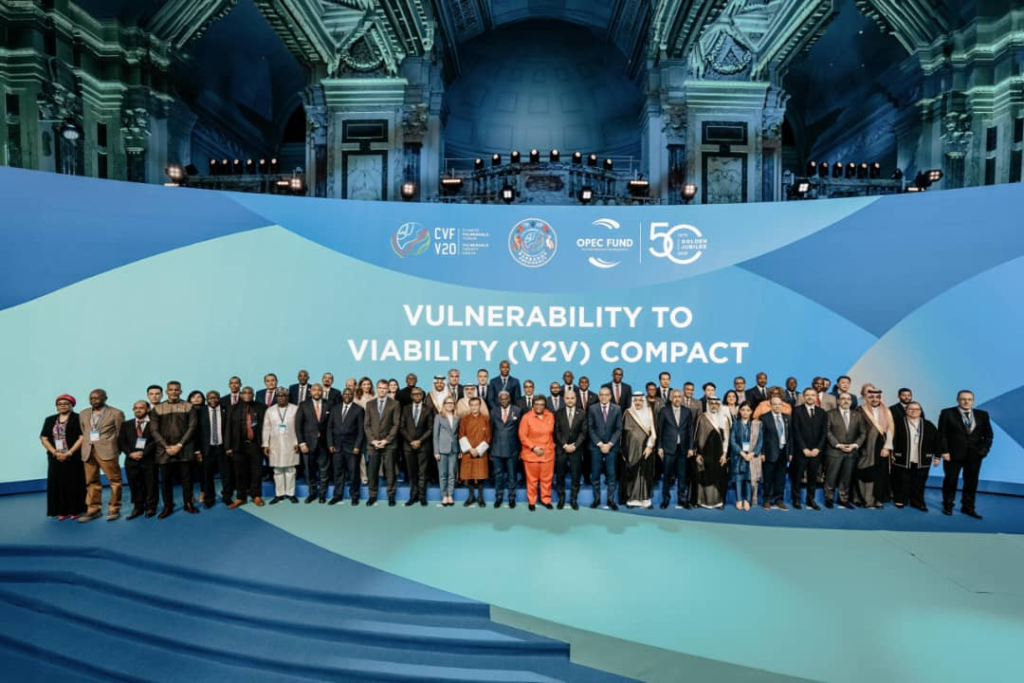
Vienna, Austria — 24 June 2026 — The Chairman of the Presidential Initiative on Climate Change, Renewable Energy and Food Security (PI‑CREF) Hon. Dr. Kandeh K. Yumkella, participated in the high-level Vulnerability to Viability (V2V) Compact Roundtable held at the historic Hofburg Imperial Palace in Vienna.
Convened by the OPEC Fund for International Development in partnership with the Government of Barbados, the roundtable brought together leaders from 78 climate-vulnerable economies, including heads of state and government, ministers, and development finance institutions, to chart a new pathway for resilient and inclusive global development.
Representing Sierra Leone and climate-affected communities across the Global South, Dr. Yumkella delivered a powerful message: “Vulnerability is not a verdict—it is a turning point.”
Advancing a New Development Paradigm
The V2V Compact represents a bold shift in global financing frameworks, prioritizing country-led solutions, equity, and long-term resilience-building investments. Its four pillars combine concessional financing, private capital mobilization, and shock-responsive instruments to protect essential services and strengthen resilience before, during, and after crises.
Scaling Concessionality – Focuses on improving the affordability, accessibility, predictability, and suitability of financing for critical sectors such as water, education, and health. A key challenge is the mismatch between long-lived infrastructure assets—often lasting 50 to 100 years—and short-term financing structures that typically span only 10 to 20 years.
Mobilizing Private Capital
seeks to unlock private and philanthropic investment through blended finance, guarantees, and risk-mitigation instruments. It emphasizes project preparation facilities, transaction advisory support, and scalable platforms to attract investment into underserved sectors like water, education, and health.
Country Ownership – Promotes alignment of development finance with national priorities and strategies, including Climate Prosperity Plans (CPPs) and Country Partnership Frameworks. It highlights the roles of national development banks, local financial institutions, and strengthened delivery systems to reduce fragmentation and retain value within vulnerable economies.
Shock-Responsive Debt Instruments – focuses on financial tools that protect fiscal space and ensure continuity of essential services, enabling countries to sustain investments during times of crisis.
Dr. Yumkella, who also serves as Special Envoy for the West Africa Integration and Investment Summit (WAIIS 2026), emphasized that while climate-vulnerable nations possess viable solutions, they often lack access to appropriate financing mechanisms.
“The real challenge is not a lack of solutions, but a lack of the right financing tools to bring those solutions to scale,” he said.
Amplifying the Voices of Frontline Communities
Drawing on Sierra Leone’s experience, Dr. Yumkella highlighted the increasing intensity of climate shocks affecting fragile communities—often reversing decades of development progress. He underscored the urgent need for climate justice, equitable financing, and stronger global solidarity.
“Energy remains central to development—it powers healthcare, education, water access, and economic opportunity. Without reliable and affordable energy, resilience cannot take root. With it, nations can transform,” he added.
Global Leadership for Climate Equity
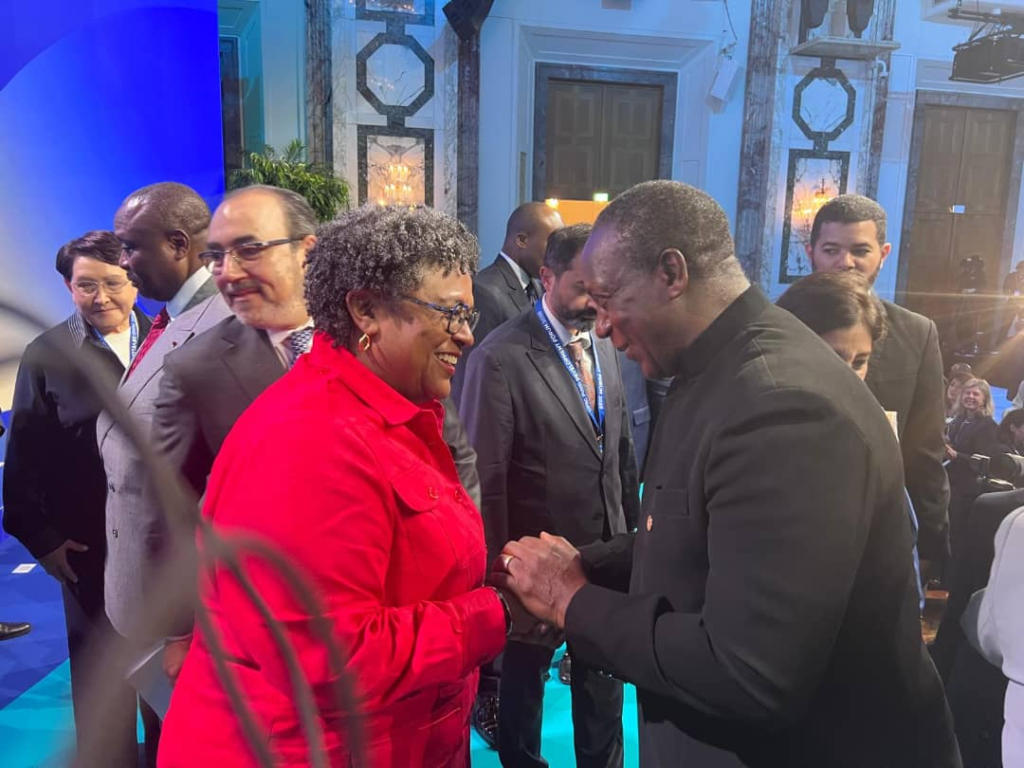
The roundtable also featured strong calls for reform of the global financial system. Prime Minister Mia Mottley of Barbados urged the international community to move beyond short-term financing cycles and invest in infrastructure that sustains human dignity over generations.
OPEC Fund President Dr. Abdulhamid Alkhalifa reaffirmed the institution’s commitment to climate-vulnerable countries, noting that more than US$17 billion has been invested in V20 economies over the past five decades.
A Shared Vision for the Future
Held in one of Europe’s historic seats of power, the gathering symbolized a shift in global leadership—placing partnership, fairness, and shared responsibility at the heart of climate action.
For PI‑CREF, Dr. Yumkella’s participation underscores a strong commitment to ensuring that countries like Sierra Leone are not only heard but actively shape global solutions.
The V2V Compact is more than an initiative—it is a growing movement grounded in the belief that the cycle of vulnerability can be broken.
Yumkella’s Strategic Relevance
With over three decades of experience, Yumkella is widely recognized for his leadership in sustainable energy and development. A development economist with expertise in agricultural economics, he played a pivotal role in advancing global consensus around the UN Sustainable Development Goals, particularly SDG 7 (energy access) and SDG 9 (industrialization and infrastructure).
As Chairman of PI-CREF, he is actively advancing Sierra Leone’s national energy transformation agenda, including expanding access, increasing generation capacity, and improving electrification. Alongside the Minister of Finance, he also co-led the team that developed Sierra Leone’s Mission 300 Compact.
He also serves as Special Envoy of President Julius Maada Bio for the West Africa Integration and Investment Summit (WAIIS 2026), where he is coordinating regional efforts to drive economic integration across four strategic pillars:
Energy Trade and Industrial Growth
Strategic Minerals and Natural Resource Development
Agribusiness and Food Systems Transformation
Digital Transformation and Connectivity
In preparation for the summit, Yumkella is leading an Expert Group Meeting and Ministerial Conference in late April 2026, aimed at validating investment pipelines, aligning policy frameworks, and adopting the Freetown Communiqué to guide regional action.
Amplifying Africa’s Voice
Yumkella’s appointment ensures that Africa’s perspectives are represented at the highest levels of global energy decision-making. The continent faces the dual challenge of closing persistent energy access gaps while powering industrial growth and climate-resilient development.
His experience across multilateral institutions and national policy frameworks positions him to advocate for practical, scalable solutions tailored to developing economies—including innovative financing, decentralized energy systems, and regional energy integration.
A Timely Appointment
The panel’s formation comes at a critical moment for global energy systems, which are under increasing strain from geopolitical tensions, climate change, and rising demand driven by digitalization and industrial expansion.
In this context, the concept of energy abundance reframes the global conversation—from simply expanding access to ensuring sufficient energy for long-term economic transformation.
Yumkella’s inclusion reflects both his global standing and the growing importance of African leadership in shaping the future of energy.
Looking Ahead
The panel is expected to conclude its work with a major report in 2028, outlining actionable policy recommendations and investment strategies to accelerate progress toward universal energy abundance.
For Sierra Leone and the wider African region, Yumkella’s role represents a strategic opportunity to help shape a more inclusive, sustainable, and development-driven global energy future.
Contact:
Anthony Abdul Karim Kamara, Jnr | Director – Partnerships, Communications and Outreach Presidential Initiative on Climate Change, Renewable Energy and Food Security (PI-CREF) Executive Office of the President | State House | Freetown
Tel: +232.78.795.305 | Email: akkamara@statehouse.gov.sl